
The Construction Industry Knows Where It’s Going. Getting There Is the Hard Part.
Modular, Robotics & Industrialized Construction.
87 MEET: Design & Build brought together five voices from the front lines of construction innovation and one conviction emerged above all: the future of building is collective, or it isn't.
On May 19, a small group gathered for an honest, unfiltered session on the state of design and build in Belgium and beyond. Hosted by EightySeven, the format was intentional: no polished stage presentations, no curated success stories just real talk about what works, what doesn't, and what keeps people awake at night.
Speakers Jente Van Genechten (WALLY), Eric Van de Heyning (Wood Inc.), Andras Cserkuthy (GLT), Joachim Schouten (Nurban Space), and Isabelle Dumon (Cordeel Group) brought perspectives ranging from early-stage robotics to fourth-generation family businesses, from circular wood construction to space-saving furniture and HVAC prefabrication.
A big thank you to all speakers and participants who made this session what it was.
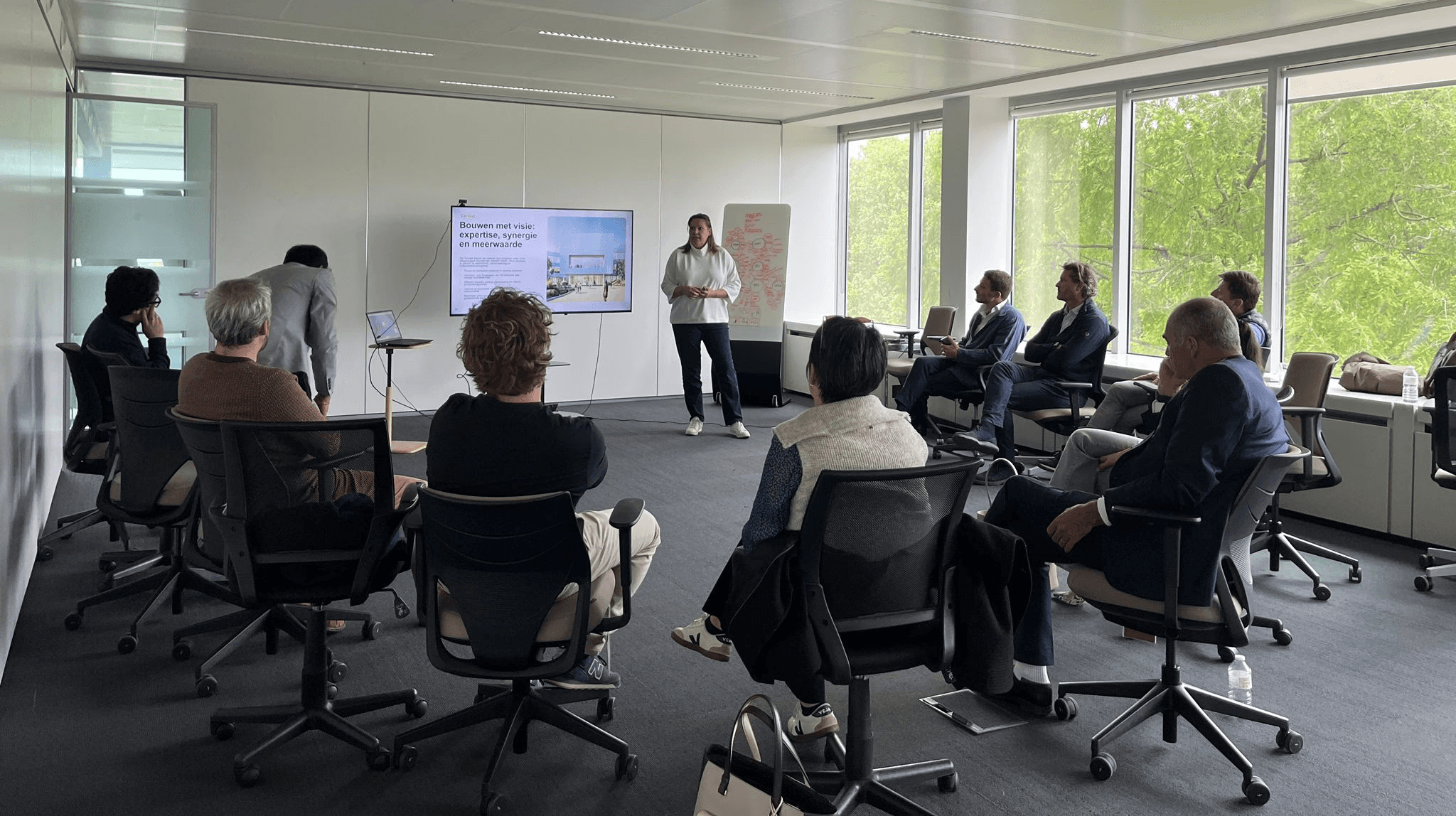
Five speakers, five different companies, one shared conclusion: the construction site as we know it has to change.
Jente Van Genechten, CEO & Founder - WALLY: The robot that builds walls, one brick at a time.
Jente started as a contractor himself and quickly faced the limits of time, labour and scale. His answer: automate one of the most repetitive parts of construction, interior wall building.
WALLY is developing a robot that builds brick walls on-site, guided by vision and supported by one operator. After a first pilot, the team went back into R&D to improve wall straightness and quality before going commercial.
The model is simple: a subcontractor service, billed per square meter, with no upfront investment or risk for contractors.
His key message: the simplest solution often wins. A robot that does one job extremely well may be more useful than a humanoid robot trying to do everything.
Eric Van de Heyning, Founder - Wood Inc.: Circularity isn't bio-based. It's about residual value.
Eric challenged the idea that circularity is only about using bio-based materials. For him, true circularity means designing buildings so that elements can be dismantled, reused, transformed and keep their residual value.
Wood Inc. works with a mechanical post-and-beam wood system: pre-cut, numbered and assembled without screws, nails or glue. Their projects show how the same elements can be dismantled and rebuilt into a completely different structure.
His key message: circularity is not only an environmental topic. It is also a financial one. If building elements can be reused, they keep value over time.
Andras Cserkuthy, CEO - GLT: Move the work to the factory. Leave almost nothing for the site.
András shared a clear productivity mindset: move as much work as possible from the construction site to the factory.
His company uses 3D laser scanning, detailed BIM design, prefabrication and lean on-site assembly for HVAC systems. The result: faster delivery, fewer errors, less waste and more predictable costs.
One example: a MEP plant room planned for 9 months was completed in 7 weeks. Material waste is reduced from an industry average of 15–20% to around 0.2%.
His key message: the tools already exist. What construction needs is the mindset to work more like an industry.
Joachim Schouten, CEO & Founder - Nurban Space: Small living is no longer a compromise. It's a response to reality.
Joachim showed how small living is no longer a niche or a compromise. With rising real estate prices and smaller homes, people and developers are looking for smarter ways to use every square meter.
Nurban Space creates modular, space-saving solutions for studios, hotels, co-living and compact apartments. Their work helps small spaces function like larger ones, from Murphy beds to smart kitchens and storage.
His key message: people are no longer just curious about small living. They are actively looking for solutions because it is becoming a reality.
Isabelle Dumon, Director Sustainable Transformation - Cordeel Group: Everyone knows where construction is going. Change management is the hardest part.
Isabelle brought the perspective of a larger construction group exploring multiple paths forward: faster concrete systems, timber façades, bio-based materials, 3D-printed elements, modular housing and more sustainable logistics buildings.
Her main point was clear: everyone knows the industry has to change. The real challenge is not only technology, but change management.
How do you shift culture, skills, processes and business models across an entire sector?
Her key message: standardization will be essential for affordable housing, student housing and scalable construction, not through one huge project, but through repeatable systems applied across many sites.
Key takeaways summary:
The construction site is becoming a place for assembly, not fabrication, the real work is moving to the factory
Circularity creates financial value, not just environmental value, reusable elements maintain residual worth and change the economics of building
Small living has crossed a cultural threshold, developers and end-users are no longer asking if compact works, but how to do it well
Regulation, overlapping certifications, and asset-class-locked permits are the most underrated blockers of construction innovation
The skills gap is real and structural, the answer is making systems so simple they don't depend on hard-to-find expertise
Change management not technology is the biggest challenge facing established players in the industry
No company solves this alone. The future of construction is built collectively.
📸 𝐒𝐞𝐞 𝐚𝐥𝐥 𝐩𝐡𝐨𝐭𝐨𝐬 𝐡𝐞𝐫𝐞
Want to be part of the next conversation? On September 16, EightySeven brings together 800 participants across construction, real estate, infrastructure, and energy working in 26 task forces on the industry's biggest challenges. Early bird pricing (€100 startups / €150 corporates) ends June 1. Discover here

