
Adapting to a Fast-Changing Built Environment
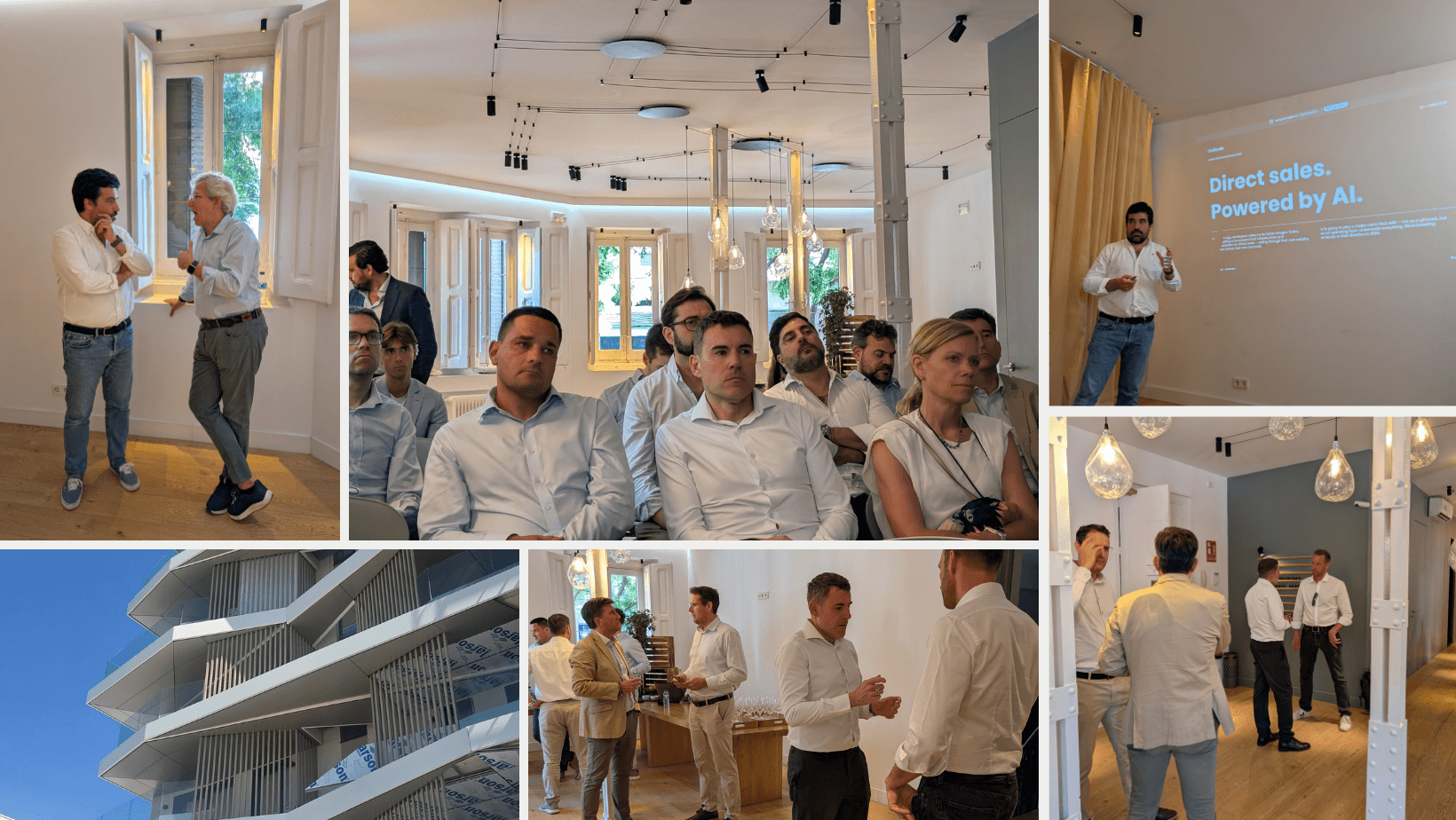
On 26 May 2026, EightySeven launched its Spanish ecosystem in Madrid with an afterwork session focused on one central question: How to adapt to a fast-changing built environment?
The evening brought together leaders and innovators to discuss energy management, digital transformation, ESG data, smart building connectivity and AI.
Speakers John Wibrand (Swegon Group), Jorge Orondo (Castellana Properties), Barny Evans (Turley), Wolfgang Lukaschek (Blue Auditor), and Joan Mitjans (Daysk) shared their perspectives on the evening's central themes. Yannick Güttler (Buildmind) and Ricardo Vicente (Onstudio) introduced their companies as part of EightySeven's market exploration bootcamp, bringing startups and scalers to validate the Spanish market alongside established industry players, alongside opening remarks from Idriss Goossens (CEO, EightySeven).
A big thank you to all speakers, participants, and partners who made this evening in Madrid possible.
The built environment is entering a different game
Idriss opened the evening by reflecting on how value is shifting from physical assets to intangible assets such as software, data and IP.
His message was clear: real estate and construction can no longer rely only on the logic of the past. Buildings, products and companies are becoming more dependent on data and software, while AI is accelerating the gap between the world we built and the world we now live in. As he put it: “We as people cannot play a game that no longer exists.”
He also highlighted that thousands of companies are currently reinventing different parts of construction, showing that the challenge is not only about finding solutions, but about adopting them faster.
John Wibrand · Digital Portfolio Director, Swegon Group: Fix the basics before adding AI
John leads digital transformation at Swegon, a company of 4,100 employees generating around one billion euros in revenue, working within HVAC, a sector responsible for roughly 20% of global CO₂ emissions when you account for both construction and operational phases.
His message was disciplined and direct: the industry is too quick to reach for AI without having the foundational data in place. Sensors that aren't accurate, sensors placed in the wrong locations, systems that aren't properly maintained all of these undermine any intelligence layered on top.
"You have to have great sensors in place. You have to understand what to do with the data. Just fixing the basics gives enormous value then you add AI on top."
His key point: air quality and thermal comfort are moving from nice-to-have to must-have. The buildings that get this right will have a measurable competitive advantage in occupancy and asset value.
Jorge Orondo · Senior Energy Manager, Castellana Properties. Energy stopped being a commodity. Now it's a strategic line.
Jorge shared how the company manages energy across its retail real estate portfolio in Spain and Portugal.
He explained that energy prices became a major challenge after a period of very low prices. In response, Castellana moved from managing energy asset by asset to taking a more centralised portfolio view.
The goal is not only to control cost, but also to find new opportunities through energy savings certificates, self-consumption and other energy-related projects.
"We have set ambitious long-term targets. But we need to act now and we need to stop seeing energy purely as a cost."
His key point: the gap between ambition and execution in energy transition is largely a structural and regulatory problem, not a technology problem. The tools exist. The timelines and permissions don't match the urgency.
Barny Evans · Director, Turley. You cannot transition energy without understanding it. And right now, most people don't.
His core argument: the energy system is fundamentally misunderstood by most of the people who depend on it. Supply, demand, and balance are the three pillars and real-time pricing is one of the most powerful tools to align behavior with reality, yet almost no one uses it.
He described a practical example: working across a portfolio of 50 different shops on a single street, no two of which are the same. Traditional auditing approaches expensive, time-consuming, requiring physical site visits simply don't scale. The platform uses available online data, satellite imagery, energy certificates, and operational records to build models that prioritize investment without requiring a full audit upfront
"Energy transition without understanding the system is difficult. But if you bring understanding and the right tools together, we can get there."
His key point: economic disruption and faster decarbonization will level the playing field faster than regulation alone. The companies that understand their energy costs in real time will have a structural advantage over those that don't.
Wolfgang Lukaschek · Founder & CEO, Blue Auditor. Most portfolios have a handful of assets responsible for the majority of their climate risk. Find them first.
Wolfgang Lukaschek discussed the connection between sustainability data and capital.
Blue Auditor works with banks, real estate investment trusts, insurance companies and asset managers to understand which assets are viable, which are at risk and where investment is needed.
"If you're just plugging into a reporting client, you're always going to be seen as a cost. You need to demonstrate the economic value of sustainability and the data allows you to do that."
He described a concrete case in Portugal: a client who installed smart meters not out of enthusiasm for efficiency, but as a practical step. Within six weeks of data collection, the platform was able to demonstrate a net operating income improvement of €10,000 more than covering the €8,000 installation cost.
His key point: buildings without credible ESG data and verification are increasingly at risk of becoming stranded assets. The market is already pricing in the risks it cannot see and transparency, supported by evidence, is the only way to recover that value.
Joan Mitjans · Revenue Manager, Daysk. The technology in your building doesn't need to change. It needs to connect.
His perspective on AI in the workplace was honest: it's genuinely difficult to predict what the effect will be. But he flagged a pattern he sees emerging companies are increasingly asking whether their AI agents, developed for internal processes, can connect with the buildings they work in. The building becomes a node in a larger intelligence layer, not just a physical space.
His answer to the question of whether buildings need to change their technology to keep up with AI: no. What they need is a central hub that connects existing systems and exposes them to the context an AI agent needs to interact with the building meaningfully.
"The technology in the building does not have to change. We need to create a central hub where all the technologies can be connected and from there, AI agents can know what features they can interact with and what data flows in and out."
His key point: SaaS as we know it may be approaching the end of its dominance. Microsoft, Salesforce, and others are already signalling this. The front-end app is giving way to AI agents interacting directly with back-end data and functionality. For smart building platforms, that is both a disruption and an opportunity.
Key takeaways summary:
The world has shifted from tangible to intangible value buildings and real estate that ignore data and software are playing a game that no longer exists
AI is only as good as the data beneath it sensors, maintenance, and basic digital infrastructure must come first
Energy has moved from commodity to strategic asset the companies treating it as an opportunity rather than a cost are pulling ahead
Sustainability risk within portfolios is highly concentrated understanding where the leverage is allows for far more effective capital allocation
Buildings without credible ESG data and verification are increasingly at risk of becoming stranded transparency is no longer optional
Smart buildings don't need to replace their technology to become AI-ready they need a connectivity layer that allows existing systems to talk to each other
AI makes efficient solutions; humans create human connection the most future-proof organisations will combine both
In Spain, studies project between 1.7 and 2.3% of jobs destroyed by AI over the next ten years but also 1.6 million new jobs created. The net balance depends entirely on how the transition is managed
Want to be part of the next conversation? On September 16, EightySeven brings together 800 participants across construction, real estate, infrastructure, and energy working in 26 task forces on the industry's biggest challenges. Early bird pricing (€100 startups / €150 corporates) ends June 1. Discover here

