
The Future of Real Estate Is Not a Feature List. It's a Feeling.
Technology and Quality of Life: The Future of the Real Estate Experience
On April 21 in Lisbon, industry leaders gathered for an afterwork session hosted by EightySeven at NOS Headquarters, in partnership with Urbanhub, LG Electronics, and Magazine Imobiliário. The discussion centered on a key question: how can technology meaningfully improve quality of life within the real estate experience?
Bringing together perspectives from innovation, development, and smart living, speakers Rui Coutinho, Yoram Speaker, Maura Teixeira, Carlos Morgado, and Diogo Serras Pereira shared insights ranging from strategic vision to real-world applications shaping how we live, build, and interact with spaces.
A big thank you to our host NOS SGPS, our partners, and our speakers for making this evening in Lisbon happen.
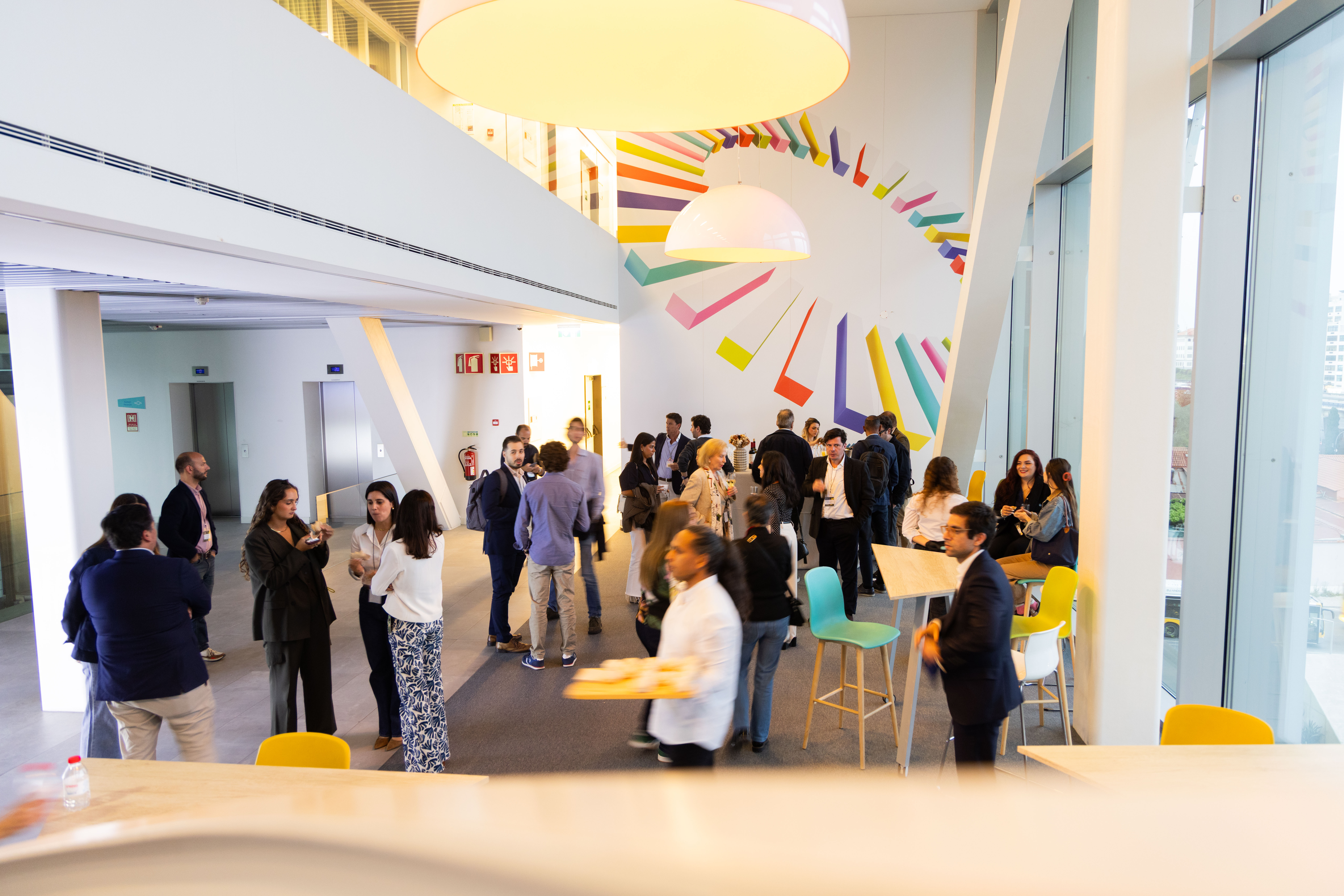
Five speakers at the Lisbon Afterwork made one thing clear: the gap between a good building and a great one is no longer technical. It's human.
Diogo Serras Pereira · Director, NOS Security & Smart Home: The smart home is no longer about controlling your lights. It's about the house learning who you are..
Diogo Serras Pereira opened with the evolution of smart homes: from basic automation and disconnected apps to AI-powered homes that learn routines, suggest changes, and eventually act on their own.
For senior residents, this could mean homes that detect falls, monitor daily patterns, and alert health services automatically especially relevant as Portugal’s population ages.
""The house will be a living organism. Like cars today versus 20 years ago, it brakes, it accelerates, it tells you what's around you. Houses will do that." - Diogo Serras Pereira, NOS Smart Home
NOS has already delivered smart home solutions to 3,500+ units and connected 40,000+ households with fiber in the past two years. Today, its systems can detect intruders, issue real-time verbal warnings through AI video analytics, and stop water leaks by cutting pumps automatically.
The key takeaway: smart home intelligence must live in the cloud, not the hardware, so homes can keep evolving without full replacements.
Yoram Speaker · CEO & Co-Founder, Gabari: 95% of real estate decisions happen subconsciously. Buyers choose what feels right, then rationalize it.
Yoram Speaker has spent 15 years helping real estate brands across Europe, the Middle East, and the US close the gap between what a project is and what people perceive it to be. His central argument: when fundamentals are strong across the board and they mostly are the differentiating factor is never rational. It's emotional.
Harvard behavioral research shows 95% of purchasing decisions are made subconsciously. The automotive industry has known this for decades. Tech companies sell ecosystems and experiences, not features. Real estate, Yoram argued, is finally catching up and the gap between projects that do this well and those that don't is widening into a price premium.
"If people don't understand it, they can't value it. Technology in real estate is invisible, complex, and poorly explained and the result is low perceived value." - Yoram Speaker, Gabari
The rational case makes a project possible. The emotional case makes it valuable and can command a premium.
His key point: make technology visible, simple, and connected to daily life benefits. “Seamless access” and “saving time daily” resonate more than feature lists like “building app with climate control module.”
Maura Teixeira · Marketing & Innovation Director Iberia, Nhood: Community is not a soft value. It is the operating system of a successful place.
Maura Teixeira’s message was clear: developers who think of communities as stakeholders to inform at the end of a project are already behind. The ones winning are those who bring communities in on day one as co-creators.
Her proof point: Viale Vigo, an intermodal station project where community workshops revealed an urban mobility barrier no planner had flagged, a brutal 12-minute uphill walk between two parts of the city. The project's response was The Hollow: a 32-second lift ride across 15 floors that now connects the lower and upper city. The community didn't just validate the project. They shaped the most impactful feature in it.
"Future-proof placemaking is not a question of prediction. It's a question of adaptability. And adaptability is the keyword." - Maura Teixeira, Nhood
Her key point: people now validate or reject projects publicly, so successful developers must design with them from the blueprint phase. Long-term relevance comes from balancing people, ESG, and profit and building communities, not just buildings.
Carlos Morgado · Executive Director, Alma Development: If you don't have a narrative, you're fighting on price. And that's a fight nobody wins.
Carlos Morgado runs Alma Development, a Portuguese developer backed by French equity, currently handing over its first buildings in Porto while preparing a 50,000 sqm phased project in Gaia. His contribution to the evening was the developer's perspective honest, grounded, and refreshingly free of jargon.
His technology philosophy: build the backbone, let the client decide the rest. Rather than pre-loading every unit with tech that may not suit the eventual buyer, Alma installs the infrastructure and connectivity layer, then leaves the application layer open. Like buying a smartphone and choosing your own apps. For a developer navigating rising costs and tight margins, this is a pragmatic hedge, future-proof by design without over-committing on features that may not land.
"If we don't have a narrative, we are fighting for price. And if we're fighting for price, we've already lost."- Carlos Morgado, Alma Development
His key point: social impact is hard to price, but it is the soul of a project. Shared outdoor spaces, community infrastructure, and places to work in the sun may cost little to build, but they can become central to the product story.
Rui Coutinho · CIO, Mota-Engil Next: Innovation theater is real. The antidote is discipline, not creativity.
Rui Coutinho closed the evening with the most structurally rigorous talk of the night. As Chief Innovation Officer of one of Europe's largest construction groups €5.3B revenue, 50,000 people, 60 countries, he has spent 26 years working out what makes corporate innovation actually work, as opposed to simply making noise.
His answer is unromantic but persuasive: innovation succeeds through process, governance, and strategic attachment, not through brainstorming sessions and innovation labs with bean bags. Mota-Engil's model is a sub-holding called Next, which acts as the group's innovation orchestrator, corporate VC, and venture builder simultaneously. Their real estate business, Emerge, is deliberately run as an innovation sandbox, the only place in the group where they control the full value chain from concept to delivery.
"Creativity without discipline generates fireworks. Fireworks don't pay salaries unless you are a fireworks company."- Rui Coutinho, Mota-Engil Next
His key point: innovation only works when it speaks the language of business with metrics, ownership, and scalable systems.
Key takeaways summary:
Buyers choose on emotion, then rationalize. Every project needs a story not as marketing decoration, but as the core differentiator
Technology that isn't explained isn't valued. Invisible features are as good as no features
Communities are co-creators, not audiences. The projects winning long-term relevance involve them from the blueprint phase
The smart home is entering its third phase: not automation, not integration, but autonomous learning, a living organism that adapts to you
Innovation in large organizations is boring, slow, underground work. The companies doing it right are the ones you barely hear talking about it
The best buildings of the next decade won't be defined by their specs. They'll be defined by their adaptability
📸 𝐒𝐞𝐞 𝐚𝐥𝐥 𝐩𝐡𝐨𝐭𝐨𝐬 𝐡𝐞𝐫𝐞

