
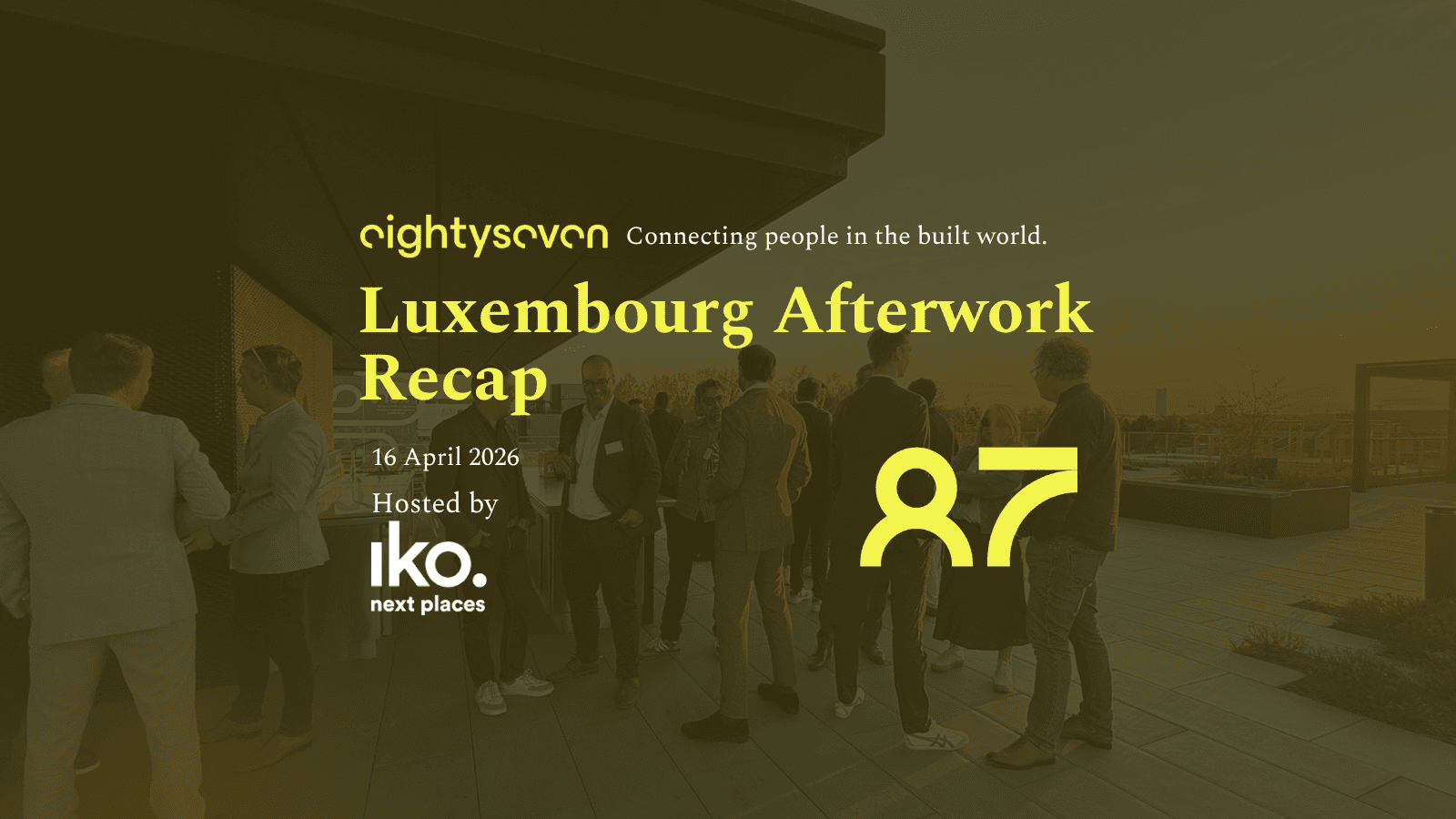
Luxembourg Afterwork 16 April, A Night of Energy, Ideas, and Connection
New Opportunities in Real Estate: Where AI, Energy, and Infrastructure Converge
On April 16 in Luxembourg, industry leaders gathered for an afterwork session hosted by EightySeven (ex-PropTech Lab), in partnership with IKO Real Estate and supported by atHomeGroup. The discussion tackled a pressing question: how emerging forces like AI, energy constraints, and geopolitical shifts are reshaping real estate opportunities across Europe.
Bringing together perspectives from consulting, deep tech, and applied innovation, speakers Patrick Laurent, Tom Van Coillie, and Idriss Goossens offered a multi-layered view from macroeconomic shifts to on-the-ground operational solutions.
A huge thank you to our host IKO Real Estate and community sponsors atHomeGroup and amazing speakers for making this happen.
Three speakers. One message: the industry is evolving faster than its cycles allow and the window to act is now.
Idriss Goossens, CEO - EightySeven: The world's value has gone intangible. Real estate needs to catch up.
In the 1970s, 90% of global value was physical. Today, 90% is intangible software, algorithms, reputation. Goossens traced how real estate's innovation focus has shifted wave by wave, and argued the next one is about converting digital ambition into real returns.
"2% of Ukraine's workforce is inflicting 50% of the damage with software-coordinated drones. That's the same shift happening in built environments." - Idriss Goossens, EightySeven
Patrick Laurent, Partner - EMEA co-lead AI - Deloitte Luxembourg
Traditional data centers: low-density, 1–20 MW. AI factories: 50–150 kW per rack, ten times the density, requiring liquid cooling and six-month build cycles even for the best operators. By 2030, data centers will consume more electricity than Japan and India combined. The bottleneck isn't talent. It's land near a substation.
"The limitation will not be talent or ideas. It will be access to energy, the grid, and well-placed land." - Patrick Laurent, Deloitte Luxembourg
Europe is 3–4 years behind the US but sovereignty is accelerating investment fast
AI token costs dropped 90–97% since 2023, yet demand is growing exponentially
Luxembourg already has players in the space: Gico (edge AI), a €1B infrastructure fund with a pipeline of new builds
Tom Van Coillie, EU Developement - Soundsensing
The most overlooked innovation in your building is the one keeping it alive.
HVAC is the largest energy consumer in most buildings and almost entirely reactive. 50% of HVAC technicians in Europe will retire within a decade. Soundsensing installs a sensor, trains an AI model in 30 days, and starts predicting failures weeks in advance. Average result: 3–8% energy drop, fewer emergency repairs, better relationships with maintenance partners.
Key takeaways summary:
Tangible assets no longer dominate global value software, data, and algorithms are the new wealth drivers, reshaping what "real estate" means.
AI inference demand is growing faster than infrastructure can be built. Land near energy substations is now a strategic asset class.
Traditional data centers and AI factories are fundamentally different products confusing them leads to misallocated capital.
Europe is 3–4 years behind the US on AI infrastructure, but sovereignty concerns are accelerating investment and creating local opportunities.
50% of HVAC technicians in Europe will retire within a decade. Buildings that don't adopt predictive maintenance now face a compounding staffing and cost crisis.
Predictive maintenance delivers measurable ROI today: 3–8% average energy reduction, fewer failures, better building-owner relationships.
Innovation adoption in real estate is bifurcating rapidly the gap between leaders and laggards is widening at an uncomfortable pace.
📸 𝐒𝐞𝐞 𝐚𝐥𝐥 𝐩𝐡𝐨𝐭𝐨𝐬 𝐡𝐞𝐫𝐞

