Go-to-Market Strategies Workshop
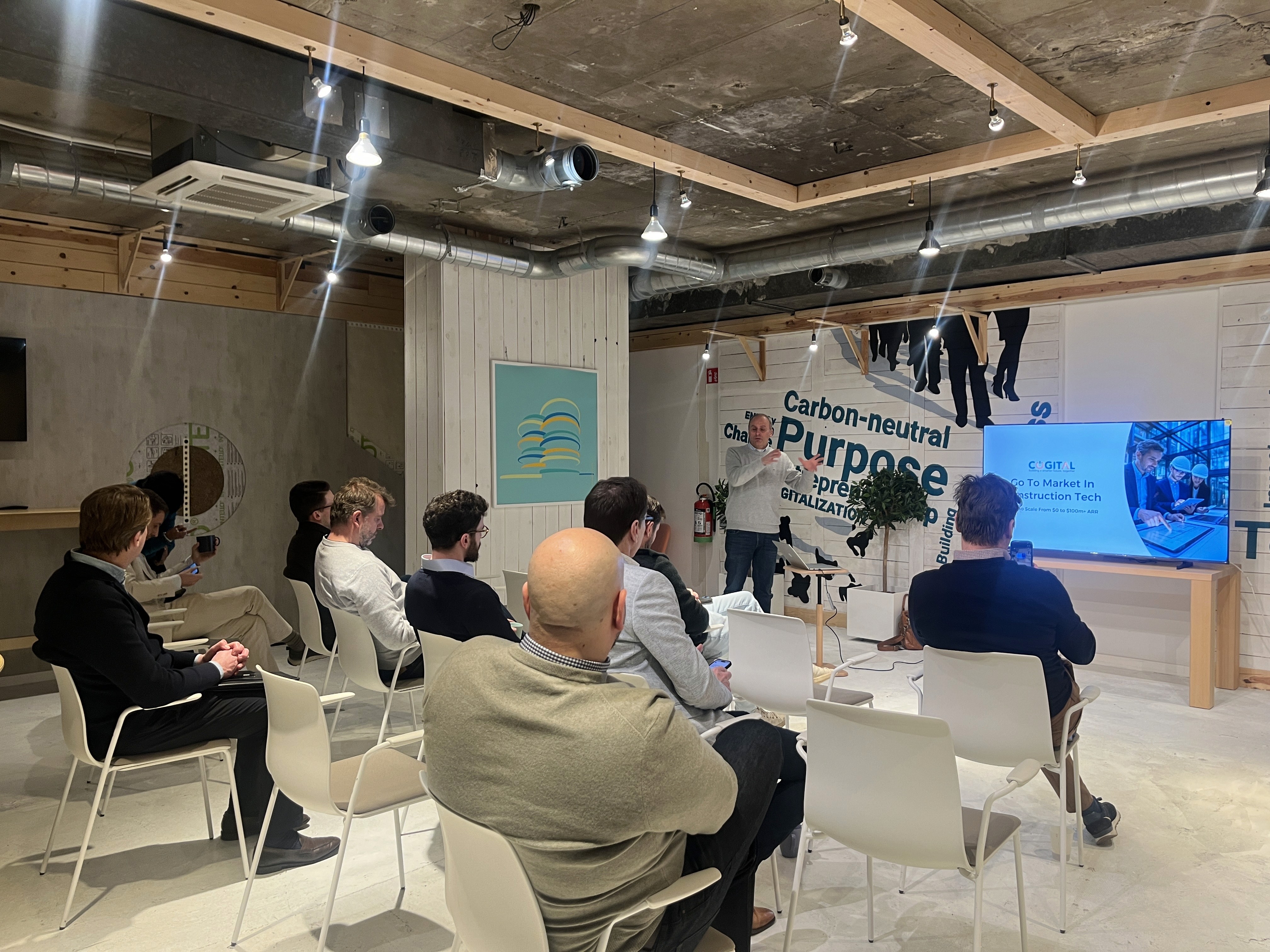
This workshop was a focused, hands-on discussion on go-to-market strategies for software and hardware companies in real estate and construction, grounded entirely in real founder challenges and practical experience.
Below is a recap of the core GTM insights shared during the session, based on the discussion and examples brought by Frank Schuyer, Entrepreneur, Advisor, GTM Specialist, Consultant from Cogital
Understanding the Market Comes Before Any GTM Tactic
There is no “silver bullet” for go-to-market.
The starting point is always deep market understanding.
Construction and real estate have very specific dynamics: decisions are often made close to the construction site, by people at lower organizational levels who ultimately decide what tools are used. Any GTM strategy that ignores this reality is unlikely to work.
Sales Cycles Are Long and Need to Be Designed For
Participants highlighted recurring challenges:
Very long sales cycles
Difficulty demonstrating value for software
Complex decision-making structures
Frank emphasized the importance of understanding all roles within the Ideal Customer Profile (ICP), especially in large organizations where responsibilities are split across departments. Managing sales cycles means constantly moving “left to right” across stakeholders.
Focusing only on large enterprises can lead to first deals taking 9–12 months or more. Several attendees confirmed that mid-market deals, while still long, tend to move faster and can help build traction and proof points.
Value Delivery Is Critical and Often a One-Shot Opportunity
In this industry, trust is everything.
Failing to deliver value usually means being “out for life” or needing a very strong comeback. Value must be demonstrated clearly and early, ideally through:
Time savings
ROI
Concrete operational improvements
Proof points should be tangible and credible, including the name of the company, the person, and their role, and should be reused in marketing materials such as videos, white papers, and external media.
Land & Expand as a Core GTM Strategy
Frank strongly advocated for a land-and-expand approach:
Start with one project
Learn from real usage
Expand to other projects or managers inside the same organization
Trying to sell too broadly too early can backfire if early feedback is negative. Learning project by project accelerates understanding and reduces risk.
Founder-Led Sales and Timing of Hiring
Founders should remain directly involved in sales until around $1M in revenue. Early customers buy trust, product understanding, and commitment—qualities that are hard to delegate too soon.
Hiring a VP of Sales too early often creates problems rather than solving them. As companies scale, founders must eventually shift from working in the company to working on the company, supported by sales teams, SDRs, and consultants.
Direct vs. Indirect Sales and White-Labeling
The workshop explored different GTM models:
Direct sales, common in B2B software, offer control but require strong internal execution
Channel and partner models can scale but are often difficult, as partners struggle to position new brands
White-labeling can create stable revenue streams, even if it introduces competitive tension
Frank’s advice was not to choose one dogmatically, but to understand the trade-offs and test what fits the business.
Product-Led Growth and Champions
For early-stage companies, product-led growth can be effective, especially when introducing new solutions that do not replace an existing competitor.
Finding internal “champions” who can experiment with the product and showcase results helps build proof points and supports wider adoption.
Visibility Over Cold Calling
Cold calling was described as largely ineffective in construction.
Instead, visibility matters:
Being present at industry events
Publishing data-driven content
Participating in online user groups to learn and observe
The goal is to build credibility and understanding before pushing sales.
Measuring What Matters
Key metrics repeatedly emphasized:
Customer Acquisition Cost (CAC)
Customer Lifetime Value (CLV)
Churn
High churn rates signal internal or product issues and should be addressed before scaling GTM efforts. These metrics are also essential for investor discussions and exit readiness.
Closing Thoughts
The session reinforced a clear message:
go-to-market in real estate and construction is about discipline, trust, and proof—not speed at all costs.
Many thanks to Frank Schuyer, Entrepreneur, Advisor, GTM Specialist, and Consultant from COGITAL for openly sharing real-world experience, concrete examples, and hard-earned lessons that founders could directly apply to their own go-to-market strategies.