Futurebuild Belgium 🇧🇪 What We Heard, What It Means
On 27 Jan 2026 at Brussels Expo – Palais 5, the conversation at Futurebuild Belgium was less about optimism and far more about realism.
The real estate and construction sector hasn’t “rebounded.” It has shifted.
Political uncertainty, tighter access to capital, mounting regulatory pressure, and the rapid acceleration of AI are fundamentally changing how decisions are made and how fast companies are expected to move.
In partnership with Futurebuild, this session brought together economists, corporate leaders, investors, tenants, and startups to move beyond headlines and unpack what is actually changing in the market—and what staying competitive now truly requires.
From Recovery to Reality
One message was clear throughout the discussion: the cost of doing nothing is now higher than the cost of change.
The sector is operating in a new reality where waiting, postponing, or running endless pilots is no longer a neutral choice. It has real financial, operational, and strategic consequences.
Productivity Can No Longer Be Ignored
While many industries have invested heavily in automation, digital tools, and industrialized processes, construction continues to lag behind. This productivity gap is no longer theoretical—it directly impacts costs, delivery speed, margins, and long-term viability.
The uncomfortable truth is that construction is not manufacturing. Volatility, fragmentation, and lack of standardization make “copy-paste” industrial models difficult to apply. But doing nothing is no longer an option. Digitalization, data, and smarter workflows are emerging as the most realistic levers for progress today.
AI Has Moved Back to the C-Suite
AI and automation are no longer seen as technical experiments or IT-side projects. They are back on the C-suite agenda, discussed in terms of efficiency, margin protection, risk management, and decision-making across the entire value chain.
However, the panel was clear:
pilots don’t transform businesses scale does.
Technology is increasingly accessible and affordable. The real barriers are organizational: silos, governance, culture, and decision-making structures. Without addressing these, AI and proptech remain stuck at the pilot stage.
A Market Splitting in Two
Another strong signal: the industry is diverging.
Some companies are pulling back, cutting innovation budgets simply to survive the current cycle.
Others are doing the opposite doubling down, testing, scaling, and preparing for what comes next.
This divide is likely to define the competitive landscape of the coming years. The winners won’t be the ones talking the most about innovation, but the ones actually embedding it across operations and strategy.
Tenants Are Driving the Shift
Tenant expectations are no longer a “nice to have.” Lower energy bills, better user experience, ESG alignment, and flexible, tech-enabled spaces are now decisive factors.
One question summed it up perfectly:
“Is the office worth the commute?”
Offices must become experiences, not obligations. And with demand for ESG-performing, tech-enabled buildings far outstripping supply, the gap represents both a risk—and a clear opportunity.
Sustainability: From Image to Liquidity
Sustainability is no longer about branding. Regulation, tenant demand, and physical climate risk are already turning inefficient buildings into stranded assets.
The message was blunt:
If sustainability feels expensive, not doing it will cost far more—in liquidity, asset value, and long-term relevance.
Progress Requires Collective Action
One point came back again and again: real estate is too fragmented to transform alone.
With landlords, tenants, operators, investors, and innovators all involved, meaningful progress only happens when stakeholders move together. Alignment matters more than individual breakthroughs.
Voices Shaping the Discussion
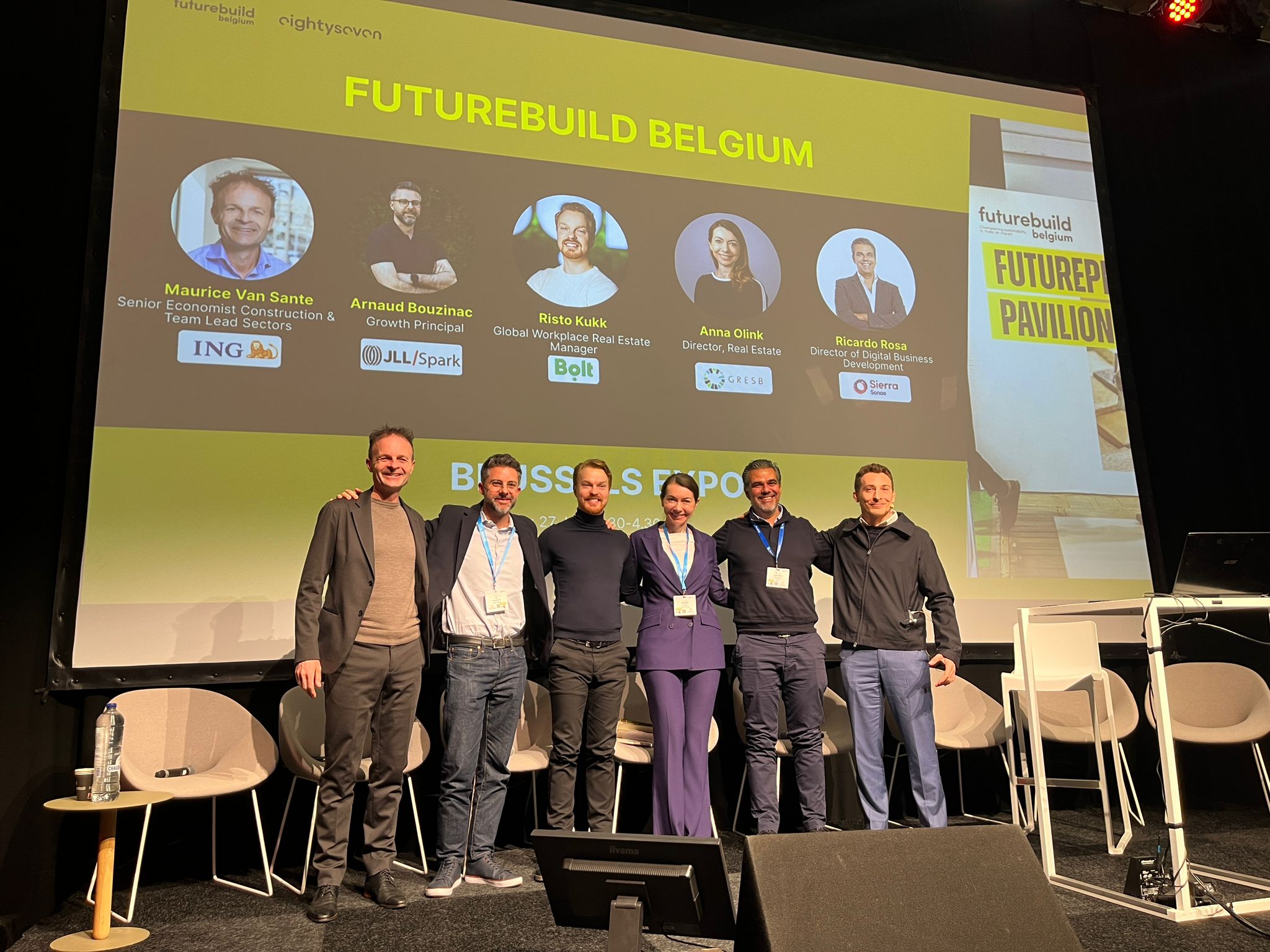
These insights were shaped by a rich and honest exchange with the panel:
Maurice van Sante (ING)
Arnaud Bouzinac (JLL Spark)
Risto Kukk (Bolt)
Anna Olink (GRESB)
Ricardo Rosa (Sonae Sierra)
And brought to life by startups working on real, deployable solutions, not slideware:
Scanbie · buildbuild · Kitehouse · JUUNOO · Earth Plus · SCOPR.AI · Visuary
With contributions from An Meersman, Marko Mihic Jeftic, Agnieszka Gansiniec, Margot Van Mol, Sabrina Dedeurwaerder, Caroline Gysels, and Julien Kistler.
Looking Ahead
This industry isn’t conservative—it’s complex.
And complexity demands clarity, coordination, and courage.
Thank you to Futurebuild Belgium for hosting, and to everyone who joined the discussion and challenged assumptions. The shift is already happening. The question now is who is ready to act and scale fast enough.