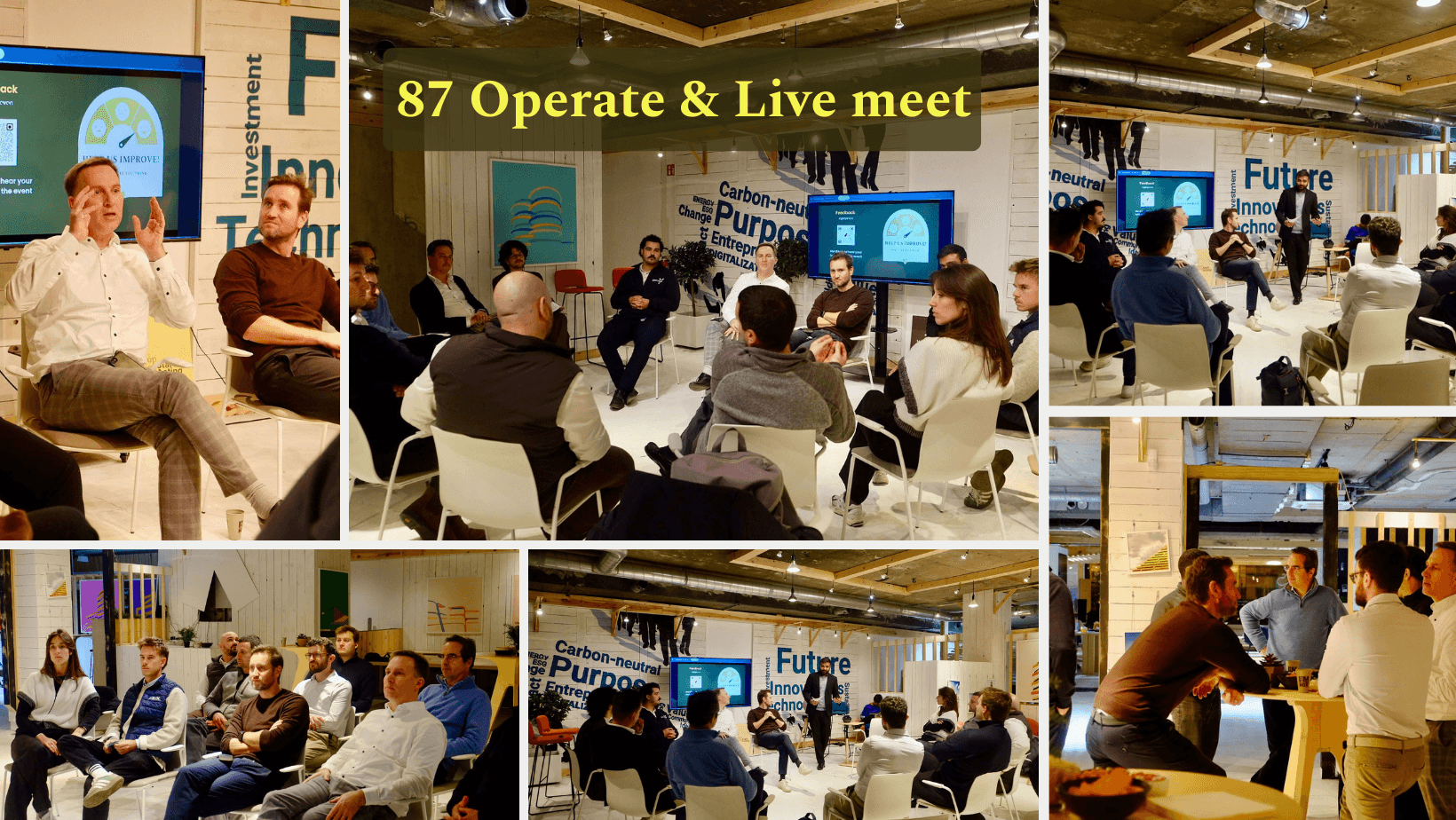
On 27 November at Urban Tech Hub Brussels, we did something different.
After years of large‑scale showcases, the Operate and Live Meet shifted the focus from big stages to intimate conversations. Instead of long keynotes, a public developer and a handful of solution providers sat at eye level and asked a simple question: how can we make building operations more sustainable, predictable and human‑centred through technology and collaboration?
The session was designed as a working meeting rather than another pitch session. Participants gathered around a table, moved their chairs into a circle and were encouraged to dig into the hard topics. The corporate side was represented by Hughes VERBROUCK of Citydev, Brussels’ public developer. In the “reverse pitch” he laid out the challenges facing public real‑estate owners and tenants - from strict ESG targets to competing demands for space. Solution providers then took turns presenting concrete use‑cases and lessons learned. Finally, a round‑table discussion brought in additional start‑ups and property managers to discuss data, mobility and building digitisation.
1. The format: from presentations to problem statements
The 87 Operate & Live Meet gathered corporates like CityDev with startups including Ask Nestor, Soundsensing and Izix through in a new roundtable format. The corporate speaker began with a reverse pitch: instead of selling a product, he posed the problems Citydev is wrestling with. Afterward, three solution providers – Ask Nestor, Sun Sensing and Izix – shared real examples of how they address similar issues. evening ended with a moderated round‑table where other innovators introduced themselves and joined the conversation. This format created a safe space for honest debate and made it easier to link problems to concrete innovations.
2. The challenges: ESG, data and people
From the corporate side, Citydev faces a complex mandate. As a public developer it must provide affordable space, foster economic activity and meet strict sustainability goals. Two years ago the organisation introduced an economic‑transition score that evaluates tenants on their business model, governance, energy use, mobility and circular practices. Tenants must score at least 33 % to sign a lease and those exceeding 50 % can receive rent reductions. This framework rewards companies that invest in greener operations, but it also puts pressure on revenue, forcing Citydev to balance ambition against financial constraints. Many buildings in the portfolio are older and lack comprehensive plans or digital documentation, and there is constant competition between housing and industrial uses.
Other challenges highlighted during the discussion included:
Challenge | Key points |
|---|---|
Tenant experience | Corporate buildings are emptying out post‑COVID. Property managers need to attract occupants with better services, hospitality and comfort rather than just rents. |
Maintenance and reliability | Traditional HVAC maintenance reacts to failures or follows rigid schedules. Predictive approaches using sensors and AI detect anomalies early, reducing downtime and improving energy efficiency |
Mobility and parking | Mixed‑use buildings with multiple tenants need flexible parking systems that optimise capacity, manage electric‑vehicle (EV) charging and support sustainable mobility policies. |
Digitisation of assets | A large share of existing buildings lack accurate plans and structured data. Without digitisation, it is difficult to integrate smart systems or apply AI. Reality capture and building information modelling (BIM) are essential first steps |
Data security and integration | Property managers worry about sharing sensitive data with third‑party platforms. Cybersecurity, closed environments and clear access controls are prerequisites for adoption. |
3. Startup use cases and innovation highlights
The meet showcased several solutions that are already helping to address the challenges above:
Ask Nestor – from reception desks to “Happy Buildings”
Ask Nestor positions itself as a hospitality company for offices. Its goal is to turn workplaces into “Happy Buildings” by combining human reception staff with digital platforms. The service includes warm welcomes, concierge‑style services (dry cleaning, food delivery, flower orders), tenant engagement (events, micro‑learning sessions) and a mobile tenant app. Ask Nestor argues that a smile at the front desk remains as important as ever. According to their own description, creating happy buildings involves hospitality‑driven spaces, well‑being and service offerings, smart building applications and community engagement. By integrating reception, services and technology, the firm believes landlords can differentiate without increasing budgets.
Soundsensing – predictive maintenance for HVAC systems
Soundsensing adapts industrial vibration‑monitoring technology to building HVAC equipment. Wireless sensors placed on pumps and fans collect vibration data. Over a 30‑day learning period the system builds a model for each machine and then monitors it 24/7. The software detects anomalies, such as pumps running outside scheduled hours or subtle vibration changes indicating future failures. By warning facility managers weeks or months in advance, predictive maintenance reduces unplanned downtime, lowers energy use and extends equipment life. The benefits of predictive maintenance are well documented: AI‑based monitoring can reduce operational costs, minimise downtime and improve energy efficiency. Soundsensing’s plug‑and‑play sensors allow a full building to be instrumented in a couple of hours, offering a fast return on investment.
Izix – smart parking as an operating system
Izix offers a smart parking management platform designed for multi‑tenant and mixed‑use buildings. The software combines IoT sensors, real‑time data and access control technologies (number‑plate recognition, mobile apps, keypads) to optimise capacity and provide a seamless user experience. Features include dynamic allocation of spaces, visitor management, EV charging management and integration with other building systems. By digitising parking, property managers can maximise utilisation, enforce policies and support ESG goals such as reduced car use and better EV infrastructure. For tenants, the system delivers flexibility and self‑service booking while reducing parking‑related friction.
Additional innovators
During the round‑table, several other companies described their solutions:
HOOBA runs shared e‑bike and cargo‑bike fleets for offices and mixed‑use developments. Its turnkey solution provides vehicles, a mobile sharing app, maintenance and fleet management, enabling property managers to offer active mobility on site
Hydrosync optimises energy consumption by using the thermal inertia of buildings as a buffer and synchronising HVAC loads with fluctuating energy prices. The company aims to maintain comfort while reducing energy costs.
Propease uses AI to extract and structure data from unstructured real‑estate documents, creating a searchable “single source of truth” for property managers.
Augment digitises existing buildings by scanning them, generating accurate plans and BIM models, and providing software to manage documentation, maintenance and sensor data. Digital twins and reality capture are crucial for connected
Yourent offers a property‑management ERP that integrates technical, administrative and accounting functions, including a ticketing system for new builds during warranty periods.
Smarteye provides dedicated connectivity for building systems and tenants. It builds separate networks for building infrastructure (e.g., parking access, solar panels, IoT sensors) and offers a hotel‑style internet experience for residents, backed by ISO‑certified cyber security.
4. Open discussion: collaboration, culture and bottlenecks
The most animated part of the evening was the round‑table. Start‑ups and corporates discussed how to align incentives and overcome adoption barriers. Several themes emerged:
Balancing ambition with reality. Public developers want to drive sustainability and innovation, but must keep rents affordable and comply with public procurement rules. Citydev’s SDG‑linked rent discounts have attracted “champion” tenants, yet the financial impact has led the organisation to consider focusing incentives on those scoring above 70 %.
User adoption matters. Many occupants simply want to work efficiently; they are unlikely to invest time learning complex systems. Hospitality‑driven services and clear communication are essential to encourage uptake. Age differences also play a role – younger, digital‑native property managers adapt quickly, while older generations need more support.
Data security and integration. Property managers are understandably cautious about sharing sensitive data. Start‑ups noted that having ISO and SOC certifications, offering on‑premises deployments and clearly defining access rights are critical to build trust. Closed environments can help protect tenant information, but there is still a need for broader data‑standardisation and interoperable APIs.
Mobility and equity. Shared mobility solutions require awareness and behavioural change. HOOBA’s biggest challenge is simply letting employees know that e‑bikes are available and free to use. Parking systems must accommodate different tenant profiles (e.g., law firms versus restaurants) and anticipate rising EV demand.
Digitisation at scale. With many buildings lacking accurate plans, digitisation is often the first hurdle. Reality capture and BIM can provide a digital backbone but scanning entire portfolios is still expensive and time‑consuming.
5. Outcomes and next steps: a shift in mindset
The key takeaway from the Operate & Manage meet is that innovation in building operations is not just about deploying new gadgets. It requires a shift in mindset from short‑term capital expenditure to total cost of ownership. Public developers like Citydev are experimenting with rent incentives tied to sustainability scores, and may soon raise the bar to encourage deeper change. Solution providers are proving that predictive maintenance, smart parking and hospitality‑driven services offer tangible returns and happier tenants. However, integration remains the bottleneck – both technically and culturally. Participants agreed that small pilots and proof‑of‑concepts are the way forward. Testing solutions in one building, gathering feedback from users and then expanding across a portfolio can build trust and demonstrate ROI.
6. Beyond formats: building a community
The Operate & Manage meet reinforced that meaningful progress happens when builders, innovators and public bodies sit at the same table. By stepping away from large stages and embracing small, challenge‑driven conversations, EightySeven is nurturing a community where problems and solutions can be shared openly. These sessions will continue quarterly, covering other segments such as design & build and invest & finance. As one participant put it, “It’s not a tech problem – it’s a trust and process problem.” Building trust takes time, but the payoff is a more sustainable, efficient and people‑centred built environment.
A huge thank you to all the founders, innovators, and corporate leaders who made this discussion so impactful: Citydev, Ask Nestor, Soundsensing, Izix, HOOBA, Hydrosync, Propease, Augment, Yourent and Smarteye.